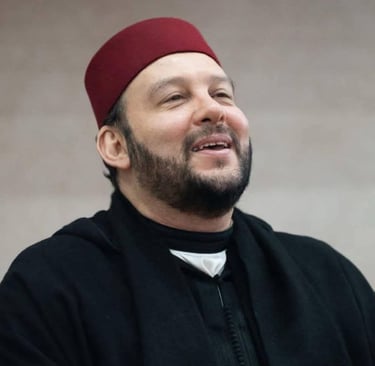
Dr. Moulay Munir al-Qadiri al-Budchichi
A personality who has been able to combine deep spiritual experience with broad cultural awareness. Born into an authentic Sufi environment founded on the education of the heart and the purification of the soul, he also spent several years in Europe, which allowed him to gain a profound understanding of its culture, its view of the human being and of the world, as well as its modern ways of thinking. This direct contact with the West enabled him to grasp the social and cognitive transformations experienced by contemporary societies, particularly the complex relationship between the material and the spiritual, the search for meaning, and the pressures of modern life.
Through this dual experience, Moulay Munir al-Qadiri al-Budchichi proposed a renewed vision of Sufism — a vision that does not separate the soul from life, and does not consider Sufism as a withdrawal from the world, but as a noble presence within it. He views authentic Sufism as a comprehensive human project aimed at restoring balance between the inner and the outer, between body and soul, between knowledge and action. For him, truth is not separate from reality, but manifests through it; and spiritual elevation is not achieved through isolation, but through a conscious and active openness.
Thanks to his familiarity with modern European thought, philosophy, and the human sciences, he has been able to present a Sufi discourse that responds to the questions of contemporary youth, in their own language and in accordance with their reality, without sacrificing the principles of spiritual discipline or distorting the depth of the Sufi experience. For him, renewal is not a break with origins, but a revitalization of those origins in light of contemporary developments. Thus, he has always advocated a Sufism that opens the doors of dialogue, builds bridges of understanding, and brings the human being back to his heart without diverting him from his civilizational role.
Moulay Munir al-Qadiri al-Budchichi has become a model of this creative encounter between East and West, between living heritage and conscious modernity. He embodies the idea that spiritual peace is not merely a personal state, but a foundation for shared human peace. Sufism, in his view, can be a language of rapprochement among peoples, a space for mutual understanding, and a path that restores human dignity in a world burdened with pressure and often lacking direction.
His experience demonstrates that the modern world does not need more conflict, but more clarity and understanding — and that Sufism, when understood in its true context, can be a universal call to love, peace, balance between soul and body, and human coexistence.
Academic Background :
Bachelor’s degree in Islamic Studies – Faculty of Letters, Oujda, 1994
Bachelor’s degree in Economics – Faculty of Sciences, Oujda, 1995
Graduate of Dar al-Hadith al-Hassania, Rabat – 1996
Diploma in Economic Sciences and Business Management – University of Grenoble, France, 1999
Postgraduate Diploma in Sociological Anthropology – on contemporary Maghreb societies, 1999
Master’s in Economic Intelligence
PhD in Human Sciences – Dar al-Hadith al-Hassania, Rabat
PhD in Religious Studies and Systems of Thought – Sorbonne University (EPHE)
PhD in Sufi Studies – Sorbonne University, dissertation on Qut al-Qulûb by Imam Abu Talib al-Makki, supervised by Professor Pierre Lory
Diploma from the Europe–Maghreb Institute, Paris, 2001
Scientific Activities and Intellectual Contributions :
Director of the Euro-Mediterranean Center for Studies on Islam Today (CEMEIA) – Paris
Professor of Islamic Finance – Paris-Dauphine University, France
President of the World Sufism Conference – M’dagh, Berkane region
Member of the European Council of Moroccan Scholars – Brussels
Chairman of the Sharia Supervisory Committee – Independent European Council for Islamic Finance
President of the Warch Association for Qur’an Memorization and the Teaching of its Sciences – Berkane
Researcher in Sufism and Communication – École Pratique des Hautes Études (EPHE), Sorbonne University