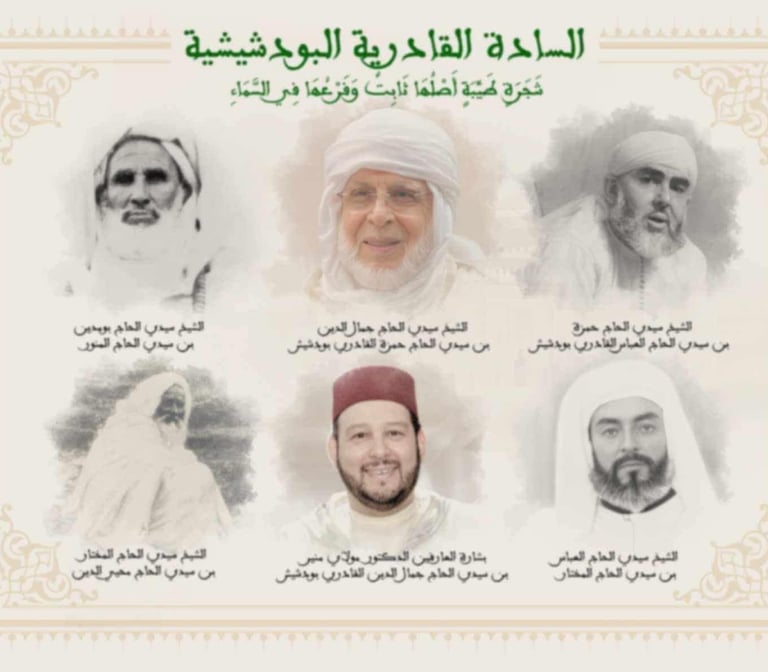
The roots of the Qadiriya Boutchichiya path go back to the venerable master Moulay ‘Abd al-Qadir al-Jilani, who lived in the 5th century of the Hijra. The name “al-Budchichiya” is linked to Sidi ‘Ali ibn Mohammed, known as Sidi ‘Ali Budchich, because he used to feed people during times of famine and scarcity with dchicha (a simple traditional food) in his zāwiya (spiritual lodge).
The Spiritual Guides of the Path:
Among the prominent figures who have led the Qadiriya Boutchichiya path in Morocco are Sidi al-Mokhtar ibn Mouhyi Eddine (d. 1914), followed by Sidi Abou Madine ibn al-Manour (d. 1955). The latter transformed the path from a simple practice of seeking blessings (tabarruk) into a true educational method based on the purification of the heart and the refinement of character, after undergoing a deep spiritual struggle and receiving authorization for spiritual training.
After him, the mission of spiritual education was carried out by Sidi al-Haj Abbas, then by his son Sidi Hamza, as the inheritors of the spiritual secret of Sidi Abou Madine. They renewed and expanded the influence and presence of the tariqa.
The spiritual leadership was then entrusted to Sidi Jamal Eddine, until he passed the spiritual torch to Moulay Munir al-Qadiri al-Budchichi.
The Spiritual Chain and the Educational Wassiya:
The spiritual chain (silsila) and the wassiya (spiritual authorization) occupy a fundamental place in the structure of Sufism. Sufi training is based on the transmission of spiritual light from an educating sheikh to a receptive disciple — a continuous and uninterrupted transmission that guarantees the authenticity and purity of the method. The spiritual chain is not merely an instructional relationship; it carries spiritual responsibility and embodies the saying of the Sufis: “The path is not acquired from books, but from the people of the path.” For this reason, Imam al-Junaid said: “Our knowledge is conditioned by the companionship of a sheikh and a master.”
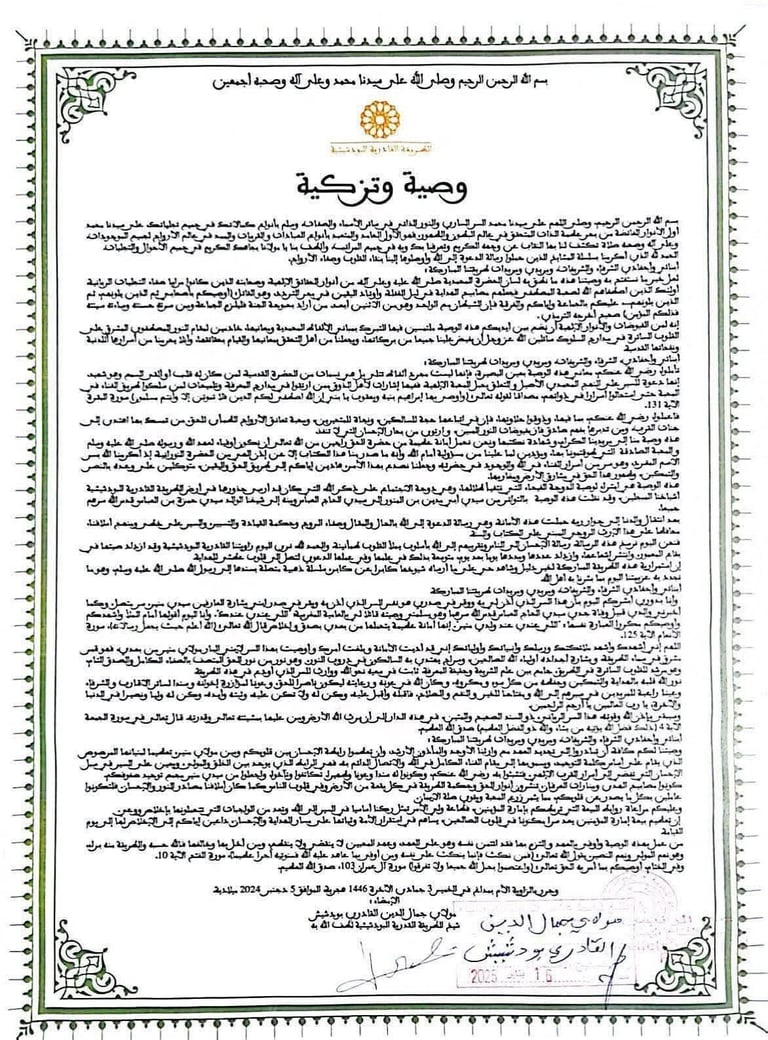
Within this framework, the importance of the wassiya (spiritual permission) becomes clear. It is granted to the one who has reached a certain degree of spiritual maturity. The wassiya is not an inheritance of blood, but an inheritance of the secret (inner spiritual knowledge) and a purification of the heart, built upon real inner readiness. It is in this way that Dr. Moulay Munir al-Qadiri al-Budchichi bears the wassiya of purification and spiritual guidance from his father, the educating sheikh Sidi Jamal Eddine — may God sanctify his soul. This wassiya confirms the authentic transmission of spiritual discipline and the teachings of purification through an original and continuous chain.
Respect for this chain is one of the defining characteristics of Moroccan Sufism throughout the ages. Indeed, the zawiyas (spiritual centers) have consistently preserved the principles of Sufi education in purifying the soul and the heart, from generation to generation, ensuring the purity of the path and the sincerity of the seeker’s journey towards God.